
I parked my small car on the side of the road and walked towards an unusual-looking mountain in the distance, hoping to take a few photographs before continuing my journey to Al Ula.
The desert was silent and open, the kind of silence that seems to stretch far beyond the landscape itself.
When I returned, an old Nissan pick-up truck had appeared beside my car. Three men were sitting inside.
“You’re from Bahrain?” one of them called through the window.
They had noticed my number plate.
“Yes, I am,” I replied.
They seemed genuinely excited to have found a Bahraini travelling alone through their part of the desert. One of them had already raised his phone and begun filming me. Before long, they were insisting that I join them for tea.
“I’m heading to Al Ula,” I explained, “and I don’t want to drive after dark.”
“It’s on our way. Don’t worry,” they replied. “You must come with us!”
I am slightly embarrassed to admit that my first instinct was to run for my life.
I was alone, far from home, surrounded by strangers in a place I did not know. Yet beneath that fear was another feeling—quieter, but somehow more certain. Something in my heart told me to go with them. It felt as though the road had placed this meeting before me for a reason.
So I followed.

After nearly an hour’s drive, we reached a tent on the outskirts of a small village, just off the main highway towards Al Ula. The sun had begun its slow descent, softening the desert in a golden light.
One of the men introduced me to Abu Abdullah.
My first impression was how remarkably clean and tidy his clothes were for a man who had been sitting in the desert chopping wood. He carried himself with a quiet dignity. I shook his hand, and he welcomed me warmly into the tent.
“May God give life to the one who comes to us,” he said. “A blessing has visited us. Welcome, people of Bahrain.”
They were the old words of Arab hospitality—words that do more than greet a guest. They make him feel that his arrival has brought something good with it.
“You came all the way from Bahrain in this tiny car?” Abu Abdullah asked as he prepared the tea over the fire inside the tent.
“I certainly did,” I answered.
“Why didn’t you at least bring a friend with you?”
I told him that I had planned to make friends along the way and that, sure enough, I was now sitting among them.
They all laughed.
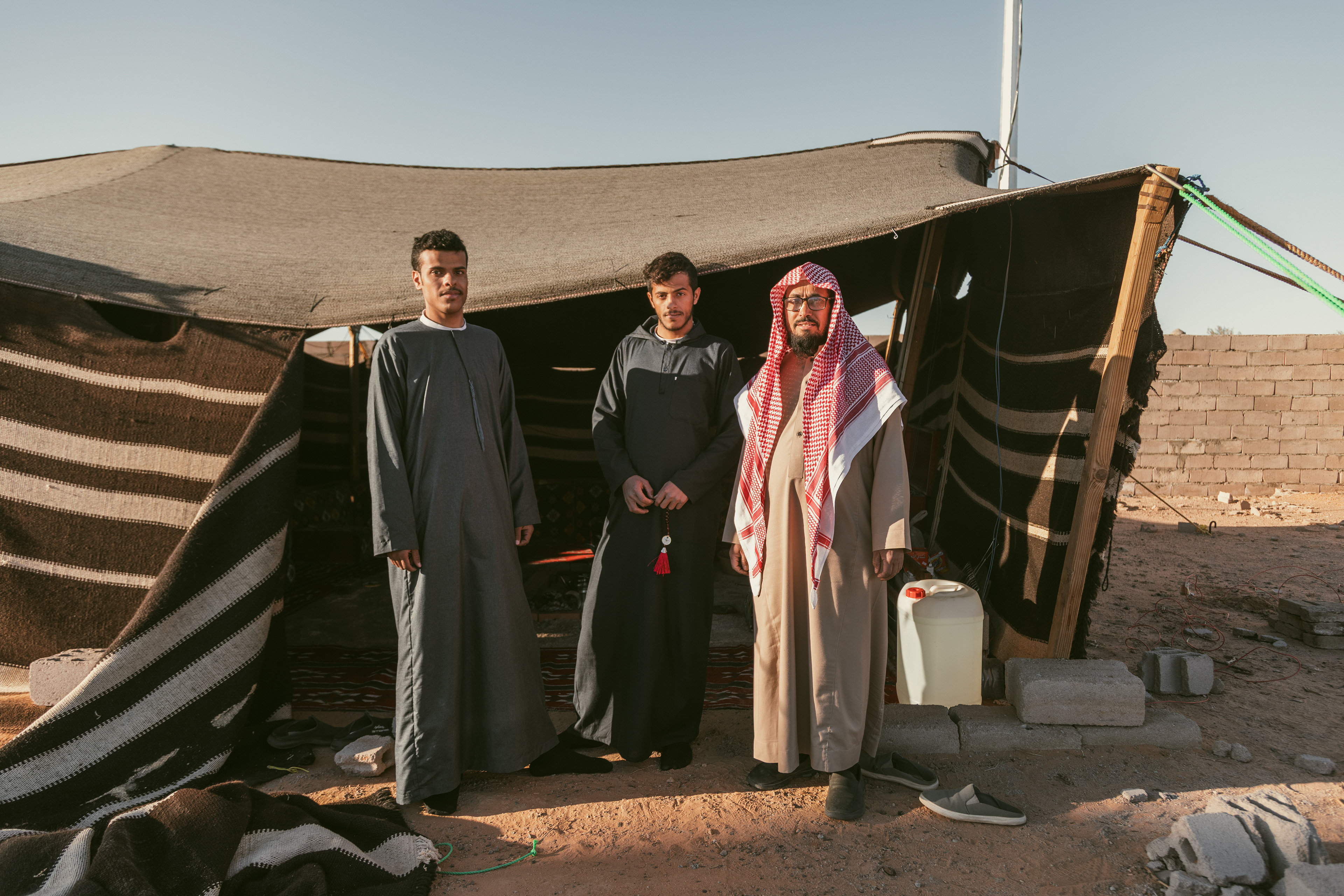
Abu Abdullah and his nephews. Al Shamli, Saudi Arabia.
As we spoke, I discovered that Abu Abdullah was a highly educated man with a master’s degree in law. He had retired early from a government career in the nearby city of Al Qassim.
After the morning prayers, he would usually sit in the tent drinking coffee with his nephews before leaving to take members of his family to school.
Although they lived modern lives, they continued returning to the desert and to the simplicity of the tent.
“The desert brings peace of mind,” he told me.
Looking around, I understood what he meant. There was very little inside the tent, yet nothing seemed to be missing. The fire burned beneath the teapot, the coffee was passed from hand to hand, and beyond the canvas walls there was only the vastness of the land.
As the tea brewed, Abu Abdullah stood and instructed us to prepare for the afternoon prayers.
When we had finished, he turned to me.
“Don’t you shorten and combine your prayers when you travel?” he asked.
“Yes, I usually do,” I replied, “but because I was praying with you, I felt it would be more appropriate to complete the prayer together.”
“Yes, that is the correct way,” he said. “When you are praying with others, you should not leave the prayer early. Some people do that, but it is not right.”
His approval pleased me more than I expected. It felt as though I had unknowingly passed a small test—not only of religious practice, but of how to conduct oneself among strangers.
For me, it had been instinctive. When you enter another person’s world, you move according to its rhythm. You sit where they sit, pray as they pray, and accept what they place before you. In doing so, the distance between stranger and companion begins to disappear.
We sat around the fire drinking Saudi coffee as Abu Abdullah spoke about the changes taking place in the country. He told me that many members of the older generation were unhappy with them.
“It is as though their minds have become locked,” he said. “No matter how much you explain that these changes are good, they will not move.”
His young nephews listened quietly, their faces curious and attentive. They told me that they hoped to visit Bahrain one day.
For the next hour, cups of tea and coffee continued to appear before me. We ate dates and spoke about family, travel, religion, society and the changes occurring around us.
Time seemed to move differently inside the tent.
On the road, I had been thinking constantly about distance, daylight and how many kilometres remained before Al Ula. But around their fire, none of that seemed urgent. There was only the conversation, the passing of cups and the quiet generosity of people who had known me for barely a few hours.
Abu Abdullah insisted that I remain for dinner, but eventually I had to take my leave of their hospitality.
Before I left, he made me promise that I would stop again on my return journey so that we could eat together.
I promised, though part of me did not want to burden them with my presence a second time. Yet I knew that they would never have considered it a burden. To them, welcoming a traveller was not an interruption to life. It was part of life itself.
When I returned to the road, the desert no longer felt empty.
I carried with me the warmth of their fire, the taste of coffee and dates, and the memory of three strangers who had appeared beside my car and welcomed me as though my arrival had been written into their day.
Perhaps this is what happens when we return to our roots and values: time becomes more generous. We no longer guard it so closely. There is enough time to sit, enough time to listen, and always enough time to live for someone else.